
Kitchen Extract Systems
Extract systems for commercial kitchens — designed, installed and cleaned.
What we offer
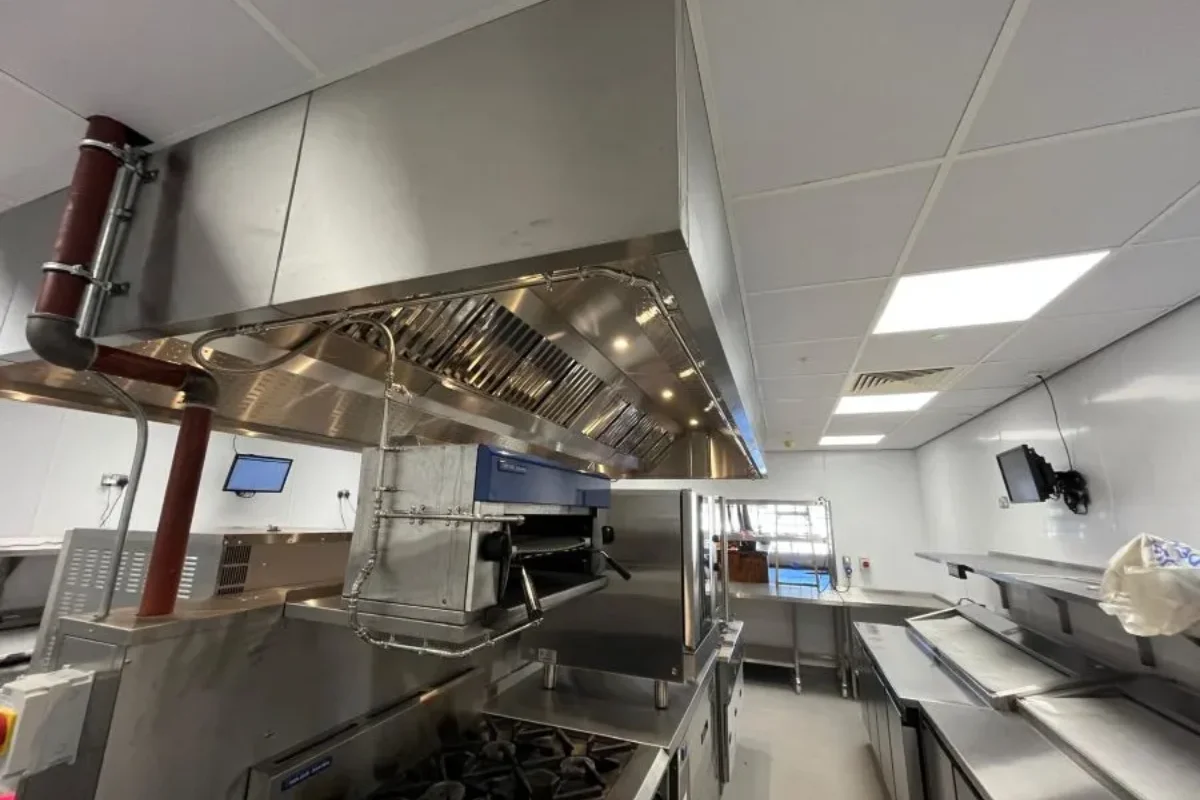
Commercial kitchens need extract systems that handle heat, grease and odour while staying compliant. We design and install canopies and ductwork, and provide TR19 deep cleans.
Grease inside a duct is fuel. That single fact separates commercial kitchen extract from every other ventilation system in a building, and it is why insurers, environmental health officers and fire risk assessors take an interest in it. We design, install, service and deep-clean kitchen extract systems for restaurants, pubs, hotels, school and care-home kitchens and delivery-only units across Newbury, Thatcham, Hungerford and the wider West Berkshire and North Hampshire area, working around service so covers are not lost.
A deep clean carried out to the TR19 Grease standard means the whole system, not the visible parts. Canopies are stripped, plenums and grease filters degreased, ductwork cleaned along its full accessible length, and the fan housing, impeller and discharge cleaned as well. Cleanliness is verified by deposit thickness testing at recorded points rather than by eye, so the result is measurable. A contractor who wipes down a canopy, changes the filters and calls that a system clean has left the fire risk entirely untouched further up the duct.
Access is the practical constraint on almost every existing system. Ductwork can only be cleaned where someone can physically reach it, and BS EN 12097 sets out how access should be provided: panels at intervals along straight runs and at every change of direction, plus access to the fan and any in-line plant. Many older installations have almost none. We survey the route first, quote for retrofitting panels where they are missing, and record any section that genuinely cannot be reached as an inaccessible area on the report.
Cleaning frequency follows cooking hours rather than the calendar. Heavy use of around twelve hours or more a day points to roughly quarterly attention, moderate use to every six months, light use to annually. What is being cooked matters just as much. Charcoal and solid-fuel grills, wok ranges and high-volume frying load a duct far faster than a kitchen doing mostly oven and boiling work, so a site with a charcoal oven or a busy fryer bank should expect a shorter interval than the headline figure suggests.
New installations are designed around the cooking line rather than the ceiling grid. Canopy length and overhang are set so the thermal plume is captured before it escapes into the room, face velocities are chosen for the duty and for whether the canopy sits against a wall or over an island, and baffle-type grease filters are specified because mesh clogs quickly and behaves badly in a fire. Duct velocity is kept high enough to carry grease in suspension towards the fan, and routing is planned with cleaning access designed in from the start.
Fan and control faults account for much of the rest. Grease accumulating on an impeller unbalances it, which chews bearings and shows up as vibration and rising current draw long before the fan stops. Belts glaze and slip, silencer media degrades, and odour control units get switched off and forgotten, which matters on sites with residential neighbours. Any kitchen with gas appliances also needs a working ventilation interlock under BS 6173, so on service visits we confirm the airflow proving device is functioning and has not been bypassed.
Every visit leaves a documented trail. Photographic evidence is taken before and after at each access point, deposit thickness readings are logged, and the report identifies inaccessible sections, damaged panels, worn filters and any fan defects found on the way. That record is what your insurer, fire risk assessor and environmental health officer will ask to see, and it builds a history of the system so cleaning intervals can be tuned to what the ductwork is actually doing rather than to a guess made on day one.
- Canopy and ductwork design to the DW/172 specification
- TR19 Grease deep cleaning with before-and-after photography
- Access panel surveys and retrofitting to BS EN 12097
- Extract fan, bearing, belt and grease filter servicing
- Make-up air provision and kitchen pressure balancing
- Odour control and discharge arrangements
- Overnight and out-of-hours visits around service times
Common questions
- How often does a commercial kitchen extract need deep cleaning?
- The TR19 Grease standard bases frequency on cooking hours: heavy use of twelve hours or more a day points to roughly every three months, moderate use to every six months, and light use annually. Cooking type shifts that considerably, since charcoal grills, wok ranges and heavy frying build deposits far faster than oven-led menus. We would rather inspect and measure than apply a blanket interval, particularly in the first year on a new site.
- We change the grease filters every week. Do we still need the ductwork cleaned?
- Yes. Baffle filters catch a useful share of airborne grease but never all of it, and what passes through condenses on the cool internal surfaces of the duct all the way to the fan and discharge. That layer is where a canopy fire finds fuel and spreads into the building. Diligent filter cleaning genuinely extends the interval between deep cleans, but it does not replace cleaning the concealed ductwork.
- Our ductwork has no access panels. Can it still be cleaned?
- Partially, and that is the problem. Without access, cleaning is limited to what can be reached from the canopy and the fan, leaving the run between them untouched and undocumented. The usual remedy is to retrofit panels at sensible intervals and at bends, which is straightforward on exposed duct and more involved above a ceiling or in a riser. Anything still unreachable afterwards is recorded as an inaccessible area.
- Will the work disrupt service?
- It should not. Deep cleans and most remedial work are scheduled outside trading hours, usually overnight or on a closed day, and the kitchen is sheeted and protected before anything is opened up. Surfaces are cleaned down and the area handed back ready for the next service. Larger installation projects are staged so the cooking line stays usable, or scheduled into a planned closure where that suits you better.
- Why is our kitchen so hot, and why do the doors pull shut?
- Both are symptoms of too little make-up air. If the extract removes far more air than the building can replace, the kitchen goes heavily negative: doors bind, draughts pull through the restaurant, and the canopy loses capture because it cannot draw freely. The fix is a designed replacement-air route sized against the extract volume and tempered for winter, not turning the extract fan down and accepting worse capture over the range.
- Our gas supply keeps shutting off when the extract is running. What causes that?
- That is the ventilation interlock doing its job, or failing incorrectly. Commercial kitchens with gas appliances must shut off the gas if extract airflow is lost, and the proving device — typically an air pressure switch or a current sensor on the fan — trips when airflow drops. Common causes are a fouled impeller, a slipping belt, blocked filters or a badly set pressure switch. Cleaning the system and checking the proving arrangement usually resolves it.
Related services
Ventilation Systems
Better airflow and indoor air quality, designed around your building.
Air Handling Units
AHU installation and maintenance for climate-controlled environments.
Commercial HVAC
HVAC for offices, hotels, schools, restaurants and care environments.
Talk to an engineer today
Free consultation, fast quotes and 24/7 emergency cover.
Areas We Cover
Kitchen Extract Systems across Newbury, Reading, Basingstoke, Oxford, London and the wider South of England — covering Berkshire, Hampshire, Oxfordshire, Wiltshire, Dorset and Somerset.